MLCC barium titanate base powder
Particle distribution, Ba/Ti ratio, phase and critical impurities.
BaTiO3 / BTO
Powder materials
Barium titanate (BTO) base powders and formulated dielectrics for multilayer ceramic capacitor (MLCC) development. Source against your composition, particle and process requirements.
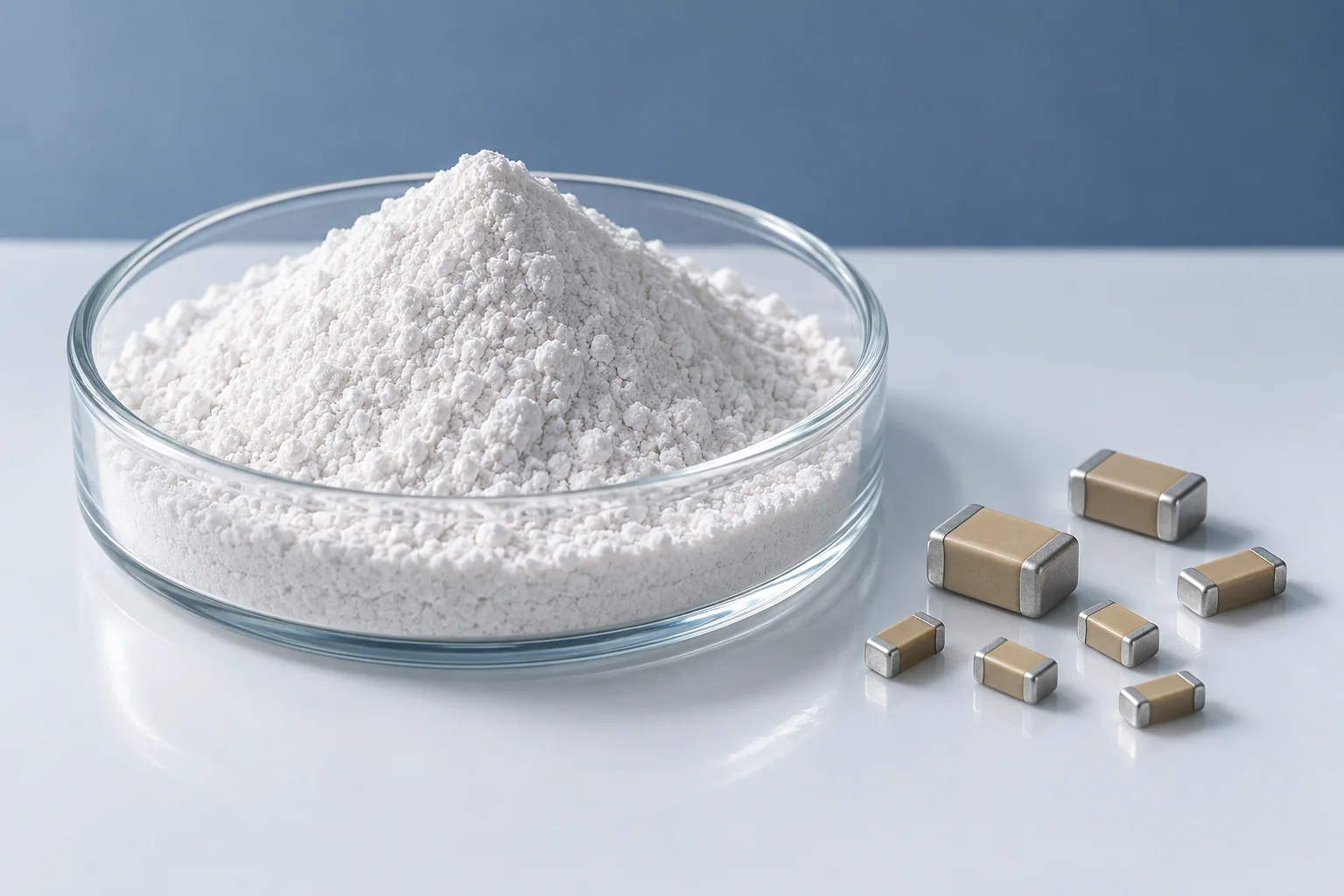
The first choice is how much formulation work you want the powder supplier to have done.
Inside a multilayer ceramic capacitor
Schematic, not to scale. Chemistry, electrode system and firing conditions must work together.
Choose the chemistry
BaTiO₃ / BTO, titanates and zirconates for your own formulation.
6 base chemistriesSpecify the preparation route
Hydrothermal or solid-state BaTiO₃ requests with particle and composition requirements.
2 BTO routesStart from a device target
X5R, X7R, X8R, C0G/NP0 or Y5V targets, evaluated in your capacitor process.
5 formulation targetsThese codes describe capacitor temperature characteristics. They help define a dielectric-powder request; the powder must still be evaluated in your device process.
| Target | Temperature range | Capacitance change with temperature | Selection point |
|---|---|---|---|
| X5R | −55 to +85 °C | ±15% | For an 85 °C upper-temperature target. Check effective capacitance at the working voltage and after aging.Discuss X5R |
| X7R | −55 to +125 °C | ±15% | For a 125 °C upper-temperature target. Keep the electrode, firing process and layer thickness with the evaluation.Discuss X7R |
| X8R | −55 to +150 °C | ±15% | For a 150 °C upper-temperature target. Include high-temperature loss, insulation and reliability requirements.Discuss X8R |
| C0G / NP0 | −55 to +125 °C* | 0 ±30 ppm/°C | For temperature stability and low-loss evaluation. Specify the intended capacitance and geometry.Discuss C0G / NP0 |
| Y5V | −30 to +85 °C | +22% / −82% | Allows much wider temperature-related change. Check that the device still meets its minimum capacitance requirement.Discuss Y5V |
*The common C0G/NP0 reference is shown here; some manufacturers use an extended NP0 range. Confirm the exact grade designation. These figures exclude DC-bias and aging effects and are not powder acceptance limits.
| Buying task | First comparison | Before sample evaluation |
|---|---|---|
| BTO or another base powder | Ba/Ti or other composition ratio, phase, primary size versus agglomerate distribution, BET and critical impurities. | Preparation route, additives already present, moisture and the composition your process will add. |
| Formulated dielectric powder | Target characteristic, electrode system (for example Ni or a precious-metal system), recommended firing atmosphere/profile and layer thickness. | Dielectric constant, loss, insulation resistance, breakdown and DC-bias/aging data with specimen geometry and test conditions. |
Choose a base chemistry, a BTO preparation route or a formulated dielectric target.
Choose the chemical system if you formulate the dielectric yourself. BaTiO3 (BTO), SrTiO3 (STO), calcium titanate and the zirconate systems remain separate requests. For BZT, include the Ti/Zr ratio.
Particle distribution, Ba/Ti ratio, phase and critical impurities.
BaTiO3 / BTO
Composition, particle profile and proposed role in the formulation.
SrTiO3 / STO
Composition, phase, particle profile and proposed formulation role.
CaTiO3
Particle profile, phase and intended dielectric/electrode-additive role.
CaZrO3
Identity, phase, particle profile and intended formulation role.
SrZrO3
Ti/Zr ratio, phase, particle profile and intended dielectric study.
Ba(Ti1-xZrx)O3 / BZT; x is grade-specific
Use these directions when the BTO preparation route is part of your requirement. For hydrothermal material, compare primary and agglomerate sizes and crystallinity. For solid-state material, include milling contamination and particle distribution.
Hydrothermal route, primary versus agglomerate size and crystallinity.
BaTiO3
Solid-state route, milling contamination and particle distribution.
BaTiO3
Choose this group when you need a formulated dielectric rather than a base chemical. X5R, X7R, X8R, C0G/NP0 and Y5V describe capacitor temperature characteristics. A candidate powder needs evaluation with your electrode system, firing atmosphere and test conditions.
Target characteristic, electrode system, firing atmosphere and evaluation method.
Grade-specific formulation
Target characteristic, layer/process requirements and comparable test conditions.
Grade-specific formulation
Target temperature characteristic, firing route and reliability evaluation brief.
Grade-specific formulation
Low-loss and temperature-characteristic targets with measurement conditions.
Grade-specific formulation
Target characteristic and intended process; compare with the complete cost brief.
Grade-specific formulation
Start with a base powder when you have your own composition and additive requirements. For a formulated dielectric, send the target characteristic or reference grade together with the electrode and firing process. We can then check which candidate grades have suitable supporting data.
Send that target and the process information you have. The temperature-characteristic label starts the discussion; the candidate composition, layer requirements and evaluation conditions still need to be agreed.
Compare Ba/Ti ratio, phase, critical impurities and particle distribution. Distinguish primary particle size from agglomerate size, and record the preparation route if it is a requirement.
A material name or reference datasheet is enough to start. Add any requirements you already know.
Nike has no fixed minimum order. Tell us the quantity you need; we’ll check supplier pack sizes and any minimums.
We’ll check the proposed grade, sample options, delivery timing and available batch documents. Include any essential COA, TDS or SDS requirements.
Send a material request